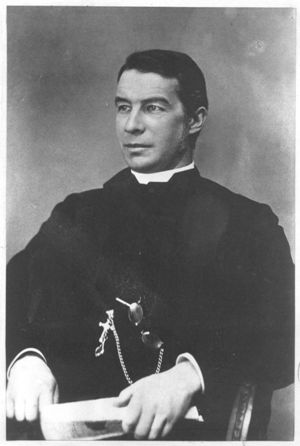
 Vincent Henry Stanton (June 1, 1846 – June 8, 1924) was a prominent English theologian and academic who spent the majority of his life shaping the study of divinity and
political economy at the University of Cambridge.
Vincent Henry Stanton (June 1, 1846 – June 8, 1924) was a prominent English theologian and academic who spent the majority of his life shaping the study of divinity and
political economy at the University of Cambridge.Queer Places:
University of Cambridge, 4 Mill Ln, Cambridge CB2 1RZ
Ascension Burial Ground, All Souls Ln, Cambridge CB3 0EA
Vincent Henry Stanton (June 1, 1846 – June 8, 1924) was a prominent English theologian and academic who spent the majority of his life shaping the study of divinity and
political economy at the University of Cambridge.
Stanton was born on June 1, 1846, in Hong Kong. He was the son of Lucy Ann Head and the Reverend Vincent John Stanton, a pioneering missionary who served as the first colonial chaplain of Hong Kong, founding both St. John's Cathedral and St. Paul's College.
Though born in China, the younger Stanton was sent to Britain for his schooling. He later matriculated at Trinity College, Cambridge, where he read both Classics and Mathematics. His exceptional academic performance paved the way for his lifelong association with the college; he graduated and was elected a Fellow of Trinity College in 1872, the same year he was ordained as a deacon.
Stanton's academic career at Cambridge was remarkably long and distinguished, spanning several decades:
Early in his career, he served as a lecturer in political economy at Trinity. He was one of the early secretaries of the university syndicate organizing popular lectures in the field.
In 1889, Stanton was appointed the very first Ely Professor of Divinity. This prestigious chair, funded by a canonry at Ely Cathedral, required holders to be ordained Anglicans. He held this post for twenty-seven years.
In 1916, he succeeded Henry Barclay Swete to the Regius Chair of Divinity, the pinnacle of Cambridge’s theological faculty. He served in this role until his retirement in 1922.
In 1904, he established and organized the famous "Stanton Lectures" on the philosophy of religion, with Vernon Storr delivering the inaugural series.
Stanton was a highly respected scholar of Christian origins and biblical authority. His major theological contributions include:
1. The Jewish and the Christian Messiah (1886) – A detailed historical study on the transition of messianic concepts from Judaism to early Christianity.
2. The Place of Authority in Matters of Belief (1891) – An analysis of ecclesiastical and biblical authority.
3. The Gospels as Historical Documents (3 Volumes, 1903–1920) – His masterwork, which meticulously examined the historical validity of the Synoptic Gospels and the Gospel of John.
Stanton was a member of the Cambridge Apostles, an elite and highly exclusive intellectual secret society founded at the university in 1820.
The Apostles brought together the brightest minds of Cambridge to debate deep philosophical, theological, and political questions in a setting of complete confidentiality and intellectual freedom. As a young Fellow at Trinity, Stanton’s election to the Apostles placed him in the company of other distinguished Victorian and Edwardian figures, including classicist A.W. Verrall, mathematician Henry Martyn Taylor, and physicist J.J. Thomson. His involvement highlights how deeply connected he was to the driving intellectual currents of late 19th-century Britain.
Stanton passed away on June 8, 1924. He is buried in the Parish of the Ascension Burial Ground in Cambridge, alongside many of the university's most celebrated academics.
A memorial brass plaque dedicated to him in the south wall of the Ante-Chapel at Trinity College honors him with the following epitaph:
"For seventy-seven years he served Christ richly with good works, defending the Christian faith in his writings and exemplifying them in his life. A serious, wise and holy man, he offered up his life, as Origen enjoins, as 'one continual prayer.'"
References:
Support this project
This website is a passion project researched, developed, and funded entirely by me. If you find the content valuable and would like to help support the ongoing research and hosting costs, any contribution is deeply appreciated.
Thank you for keeping this independent resource alive!
My books on Amazon: Elisa Rolle's books